Apparent search spikes for a Bondi Beach attacker's name overseas before the terror attack are a data mirage, not a conspiracy.
Some social media users have been sharing screenshots of results for the name "Naveed Akram" from the Google Trends website, which appear to show large search spikes in Israel, Iran and the US, before the December 14 attack.
Similar claims involving the results from the website were made after US conservative Charlie Kirk's assassination.
However, an expert statistician and Google say the spikes have been completely misinterpreted.
Google Trends is an online tool that shows the popularity of common search terms over time and across different locations.

It does not show how many times a term or topic was searched.
Instead, the website allows users to see the popularity of a specific term within a random sample of about 10 per cent of all Google searches in selected locations and timeframes.
The moment when the chosen term makes up the highest proportion of overall searches is given a score of 100.
The other scores are calculated by dividing the share of total searches the chosen term accounted for at each point in time by the share recorded on the peak day, then multiplying the result by 100.
These scores show how closely search interest for the specific term at those points in time matched the peak.
If a search term's peak popularity during a period was when it accounted for 1.0 per cent of total searches on a particular day, it would be given a score of 100.
If the same term accounted for 0.5 per cent of searches on another day during the period, then that day would get a score of 50.
Jacques Raubenheimer, a biostatistician at the University of Sydney, said this scaling method works well for common search terms, such as "weather."
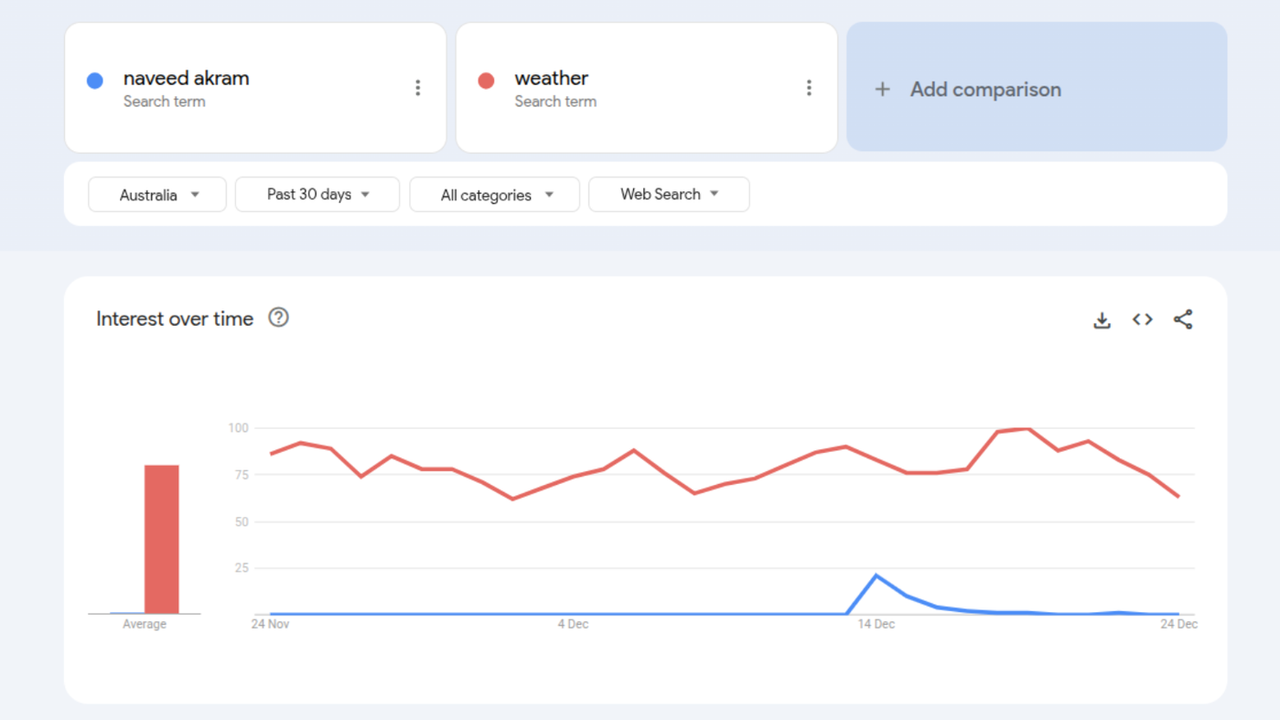
However, it backfires for obscure or uncommon names, such as "Naveed Akram," for which search volumes are near zero.
"The method they use to scale it, unfortunately, means that when there's those low volumes, the statistical noise kind of amplifies it, because the denominator you're using to scale it is such a small denominator," he told AAP FactCheck.
Google also told AAP FactCheck that spikes in such low-volume search terms may not reflect any actual searches at all.
To protect user privacy, Google deliberately adds or removes small variations in the data, known as "statistical noise."
Spikes should not be interpreted as evidence of actual search activity on a specific date or in a specific country, a Google spokesperson said.
Dr Raubenheimer likened the effect of these small variations to "static on a radio - interference that stops the real signal from coming through clearly."
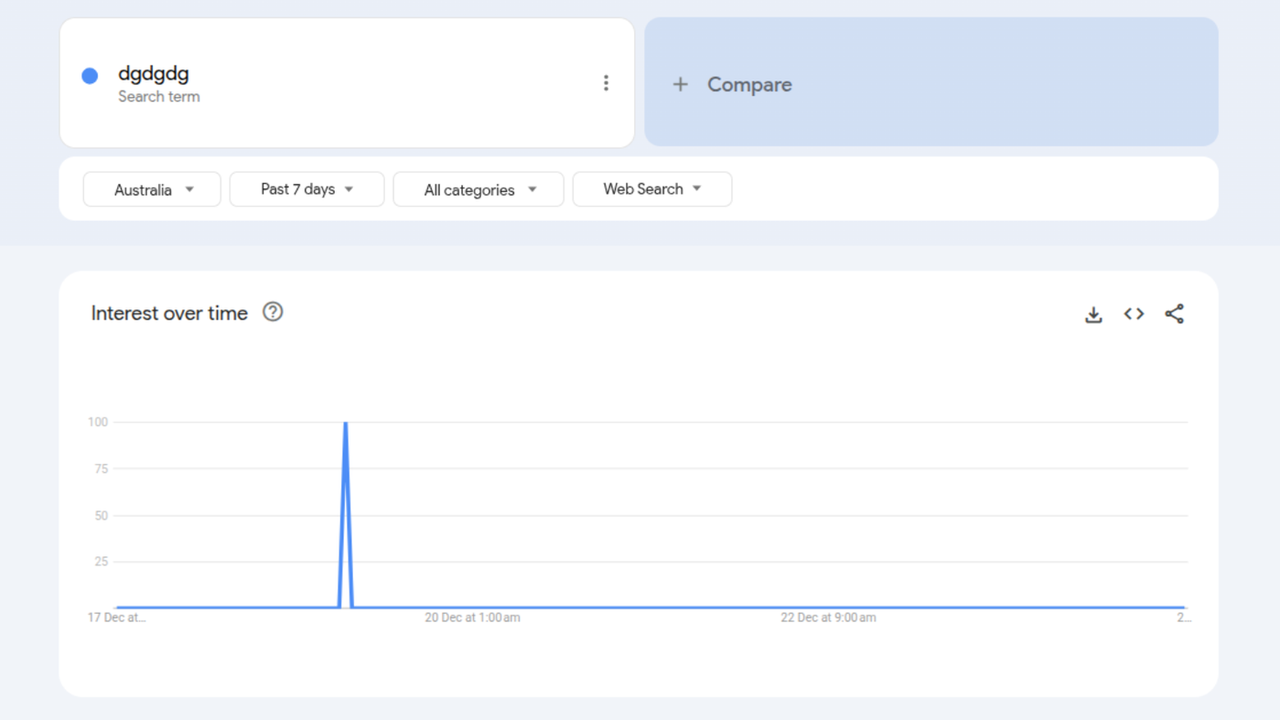
Another complicating factor is that Google draws a different random sample each time a user runs a query.
For uncommon terms, running the same search for the same country and period on different days can produce noticeably different charts.
The platform's location data is also imprecise, Dr Raubenheimer said.
Internet traffic is often routed through different cities or across borders, which can lead to searches being misattributed to specific countries.
Even time zone differences can add confusion as the results display in the Trends user's local time.
Dr Raubenheimer said this factor appeared to be overlooked in social media posts sharing chart screenshots immediately after the Bondi attack.
So for obscure terms, he said, spikes don't necessarily mean anything.
"Generally, everything with a zero trendline and then a sudden spike in values is probably not to be trusted," Dr Raubenheimer said.
"The volumes are just too low."
Google has warned that Trends "is not a scientific poll" and that its data should be used cautiously and alongside other evidence.