WHAT WAS CLAIMED
Mammograms have been suspended in parts of Australia.
OUR VERDICT
False. There is no evidence services have been suspended.
AAP FACTCHECK - Australia has not suspended breast cancer screening services, despite claims that several countries have paused mammograms due to concerns.
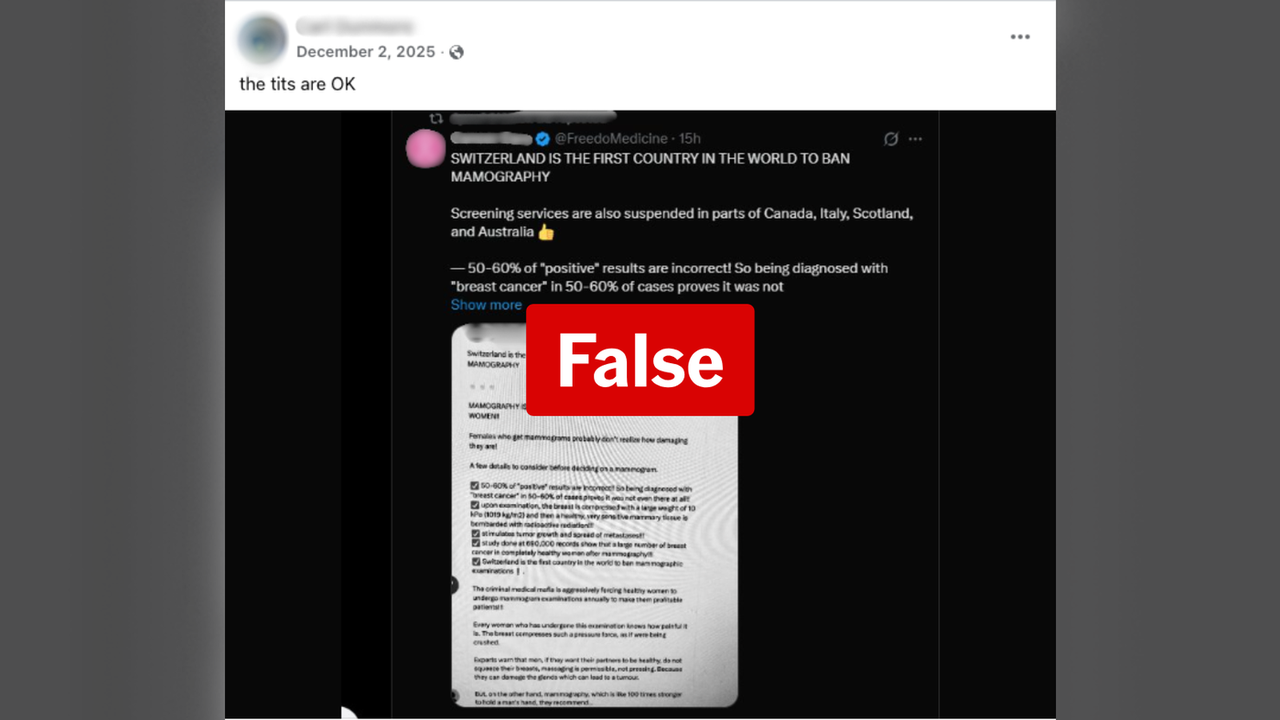
The post originated on X and was subsequently shared on Facebook. It claims that Switzerland recently banned mammograms, while other countries have suspended screenings.
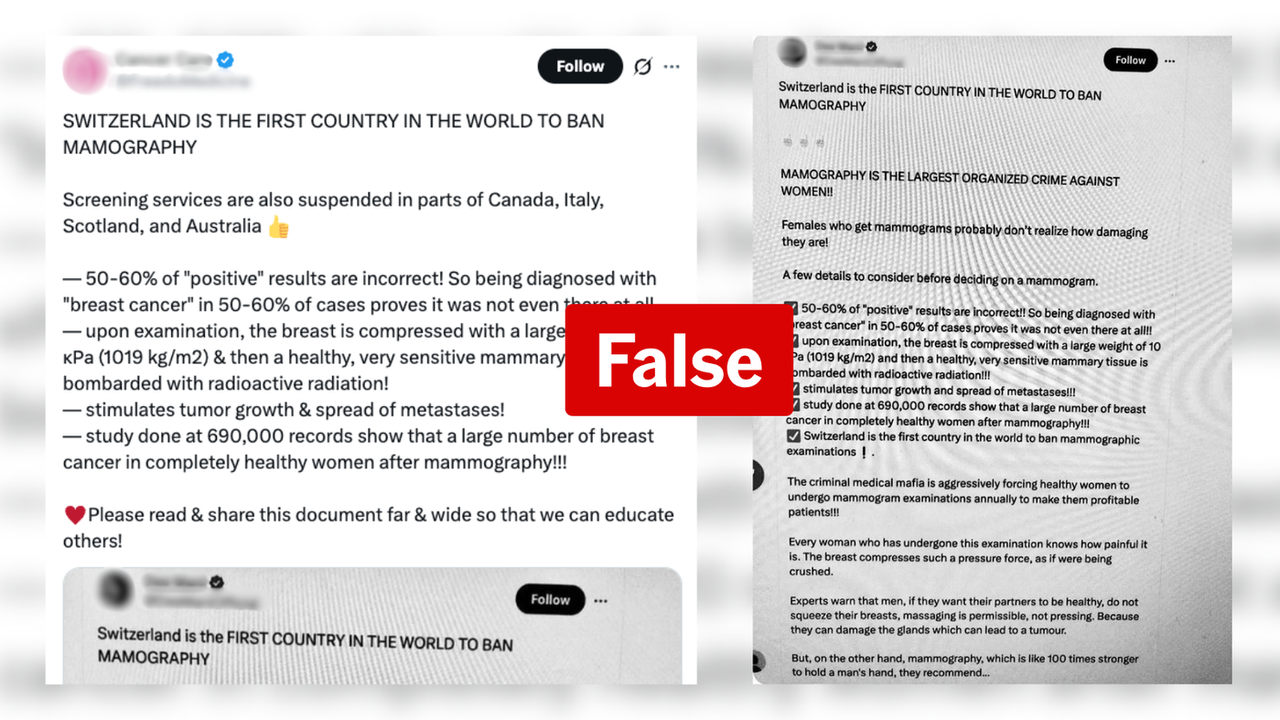
"SWITZERLAND IS THE FIRST COUNTRY IN THE WORLD TO BAN MAMOGRAPHY [sic]," the post reads.
"Screening services are also suspended in parts of Canada, Italy, Scotland, and Australia."
The post goes on to claim that between 50 to 60 per cent of "'positive' results are incorrect" and shares other claims about the risks of mammograms.
"Please read & share this post far and wide so that we can educate others," the X post urges.
However, BreastScreen Australia, which coordinates services nationally, has not suspended any mammography screening services, a spokesperson for the Department of Health, Disability and Ageing told AAP FactCheck.
"BreastScreen Australia is delivered through free, public clinics funded by both federal and state and territory governments," the spokesperson said.
AAP FactCheck has previously debunked posts circulating in 2023 that claimed breast cancer screening was banned in Switzerland.
Claims that Australia and other countries have also suspended mammograms have also been shared since at least 2024.
However, there's no evidence that Australia, Canada, Italy or Scotland have suspended mammograms as claimed.
A Canadian government website calls mammograms the "only technique proven to be safe and effective in screening for breast cancer", while official health websites in Scotland, Italy and the European Union also recommend screening.
The viral post also claims that more than half of breast cancer screening results are false positives and that mammograms stimulate tumour growth.
The 50-to-60 per cent false positive rate referenced in the post may refer to a 2022 study published in the journal, JAMA Network Open.
It found those that had a mammogram every year for 10 years had a 56 per cent chance of having one false positive test during that time - not a 50-60 per cent false positive rate for each test as claimed.
The US National Cancer Institute estimates 9.5 per cent of tested women have a false positive, while half of those who get a test each year will have one false positive result over a decade.
There's evidence the false-positive rate in Australia is lower still.
Professor Nehmat Houssami, a breast and public health physician at the University of Sydney, previously told AAP FactCheck that mammograms - like all screening tests - do return false positives and this rate varies from practice to practice.
Prof Houssami led a 2019 trial which found a false-positive, or "recall rate", of about three per cent and she said these errors were usually picked up by further testing.
The radiation from X-rays involved in mammograms is also small and outweighed by the benefit of early detection, Prof Houssami said.
An England National Health Service review concluded that for every death caused by radiation-induced cancer from mammograms, around 150 lives will have been saved through early detection.
An Australian health department spokesperson told AAP FactCheck that breast cancer screening offers clear benefits.
"Cancers detected through BreastScreen are associated with a 54 to 63 per cent lower risk of death compared to cancers in women who have never been screened," they said.
Other research, however, points to a lower effectiveness of mammography.

A 2020 review of evidence of breast screening on mortality in Europe found those who attended breast screening had a 12-to-58 per cent reduced risk of dying from breast cancer.
As for private clinics and breast cancer screening, Australian officials said they did not know of any clinics suspending services.
Similar false claims about mammography suspensions in Australia and other countries have also been debunked by AFP Factcheck.
AAP FactCheck is an accredited member of the International Fact-Checking Network. To keep up with our latest fact checks, follow us on Facebook, Instagram, Threads, X, BlueSky, TikTok and YouTube.