

WHAT WAS CLAIMED
A New Zealand news Facebook page is publishing images and footage of breaking events.
OUR VERDICT
False. The images and footage are AI-generated.
AAP FACTCHECK - A Facebook page that claims to be a New Zealand news outlet is pushing out a steady stream of AI-generated content that misrepresents actual events.
The page calls itself NZ News Hub, a name similar to the now-defunct New Zealand news organisation Newshub, which closed down in 2024.
The page regularly churns out stories based on New Zealand breaking news and reporting by legitimate media outlets.
However, it also adds images and video generated using artificial intelligence (AI).
The page's bio proclaims "NZ News Hub brings you the latest New Zealand news, breaking stories, politics, business, sport, and community updates", but it does not appear to contain any original reporting.
AAP FactCheck recently debunked several false AI images it published of the Mt Maunganui landslide that killed six people in January, but those are just the tip of the iceberg.
AAP FactCheck contacted NZ News Hub with a series of questions, but did not receive a response by the time of publication.

Dr Andrew Lensen, a senior lecturer in AI and programme director at Victoria University of Wellington, told AAP FactCheck the page's images were clearly AI-generated.
"These pages want to get as much engagement (reactions, comments, shares) as possible, in order to build their following/exposure and potential ad revenue," Dr Lensen said.
The fake images could also avoid copyright issues that could come by taking images from legitimate media sources without permission, he said.
The AI content could also erode trust in legitimate news sources, Dr Lensen said.
"Trust in journalism is already a huge concern, and any source that presents itself as a fake source of news will just increase distrust further."
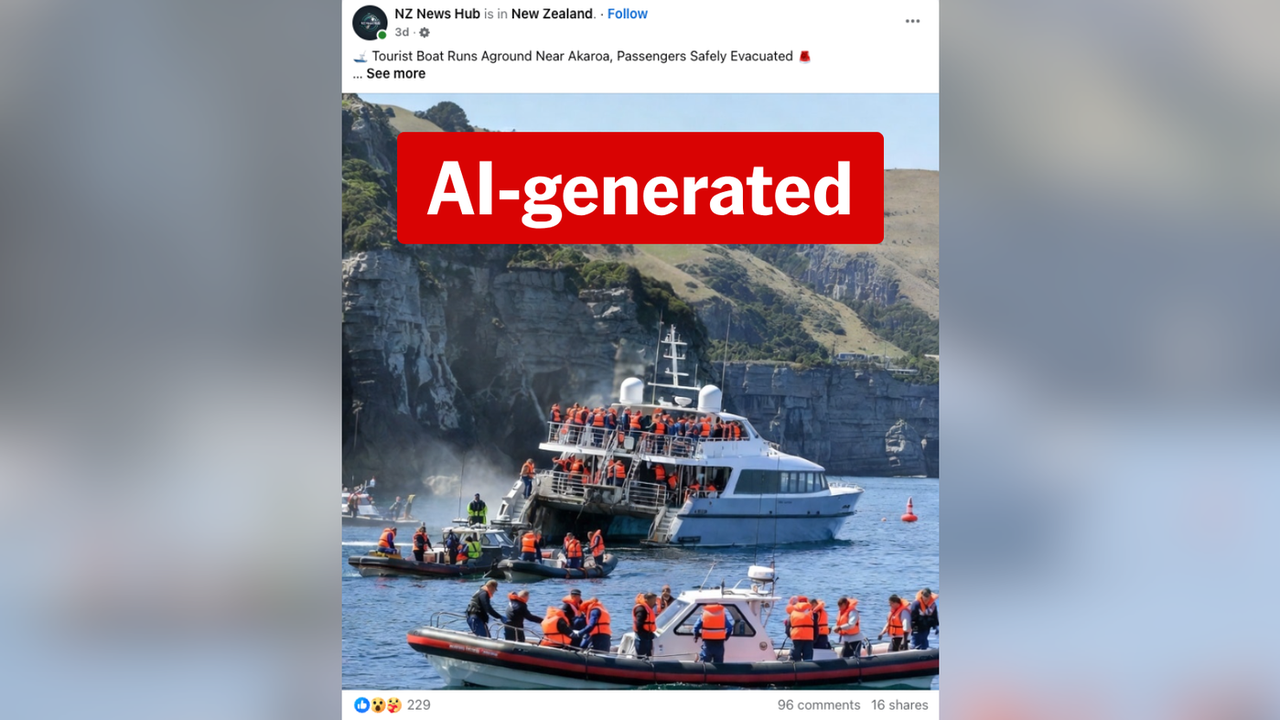
In recent weeks, the page has published images that it claims show tourists being rescued from a wildlife sightseeing boat that capsized off Akaroa Head near Christchurch on January 31, where 41 people were rescued.
However, the image does not resemble Akaroa Harbour, where the boat capsized. Several people's faces are clearly distorted, a common indicator of AI generation - one appears to have no head.
The boat depicted is also different to the actual Black Cat boats on the company's website, and the image doesn't match footage of the sunken boat published by Stuff and other NZ media.
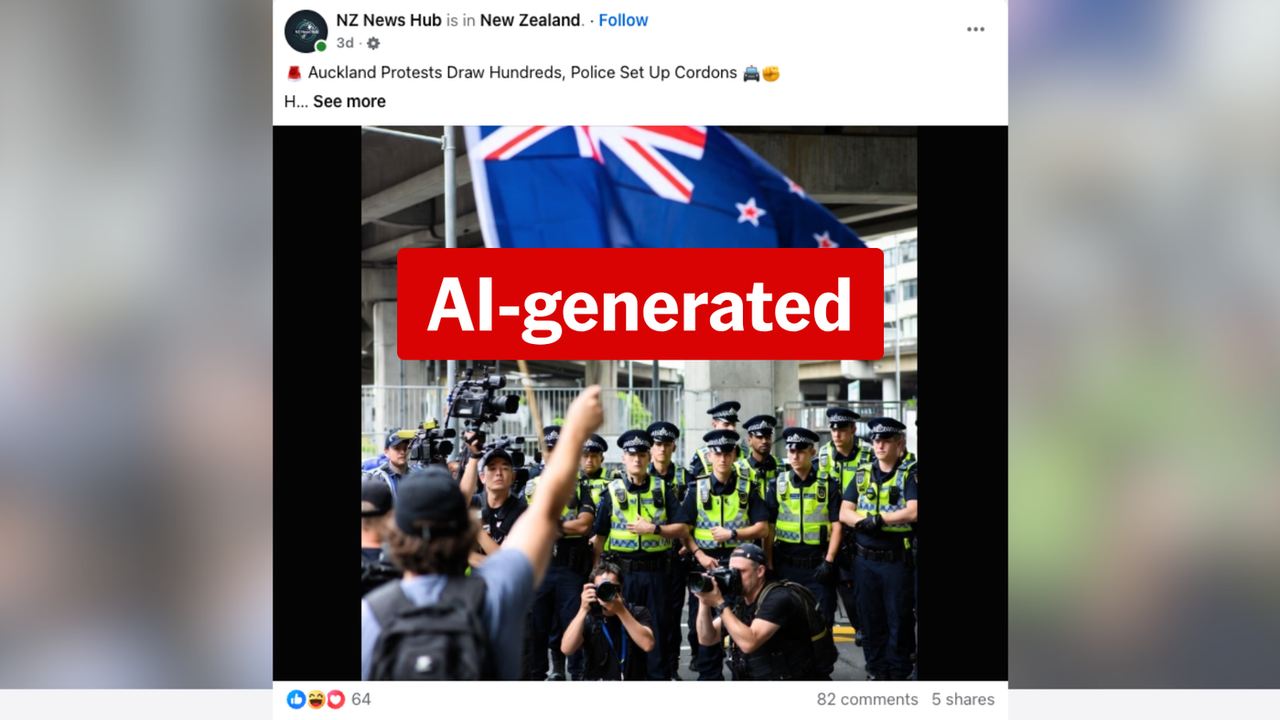
Another image that claims to be from anti-immigration protests in Auckland on January 31 is clearly AI.
Almost all of the police officers' faces in it are distorted and the uniforms are the wrong colour and do not match photos of police from coverage of the protests by the New Zealand Herald and RNZ.
Another post repurposes reporting from a recent RNZ story about kereru, the large New Zealand native wood pigeon, running into glass windows.

However, the Facebook page's post uses yet another suspected AI image of a bird that is not a kereru.
An image the page claims to be of recent disruptive dirt bike riders in South Auckland also appears to be generated by AI.
The figures in the image appear distorted and the police cars shown aren't NZ police vehicles.
The page also appears to use AI to animate still photographs taken from media outlets, including of deceased victims of recent disasters.

One post uses AI to animate a photo of Mt Maunganui landslide victim Sharon Maccanico, 15.
The original still photo released by NZ Police shows Sharon dancing, but there was no video of her dancing released by the family and the video posted by NZ News Hub features several highly unrealistic acrobatic dance moves.

Another post animates a photo from a news story about the Central Otago District Council granting road access to a mining company, as seen in the Otago Daily Times and elsewhere.
Yet another post uses AI to animate a still image from an RNZ story about the grieving family of a Tauranga teenager who died by suicide.

The reporter who wrote the RNZ story confirmed to AAP FactCheck that no such video was taken during that interview.
Another post uses AI to animate a still photo by RNZ photographer Calvin Samuel of Finance Minister Nicola Willis speaking with Prime Minister Christopher Luxon.
The words spoken by Ms Willis don't match her mouth movements and don't match the actual footage of the January 19 press conference published by RNZ.
AAP FactCheck is an accredited member of the International Fact-Checking Network. To keep up with our latest fact checks, follow us on Facebook, Instagram, Threads, X, BlueSky, TikTok and YouTube.





.jpg)
