WHAT WAS CLAIMED
A Green Party proposal will see hundreds of thousands of New Zealanders paying nearly half their income in tax.
OUR VERDICT
Misleading. Hundreds of thousands of New Zealanders would not pay nearly half of their income in tax under the policy.
AAP FACTCHECK - A senior New Zealand minister has suggested hundreds of thousands of Kiwis will pay nearly half their income in tax under the Green Party's tax policy, but that's misleading.
The proposed 45 per cent rate would apply only to the portion of a person's earnings above $160,000, not their total income.
National MP and campaign chair Simeon Brown made the claim in a June 21 Facebook post after the Greens released their tax policy ahead of the November 7 election.
"The Greens' wild tax plans seem to be the only solution to Labour's $18 billion shortfall in its costings," Mr Brown wrote.
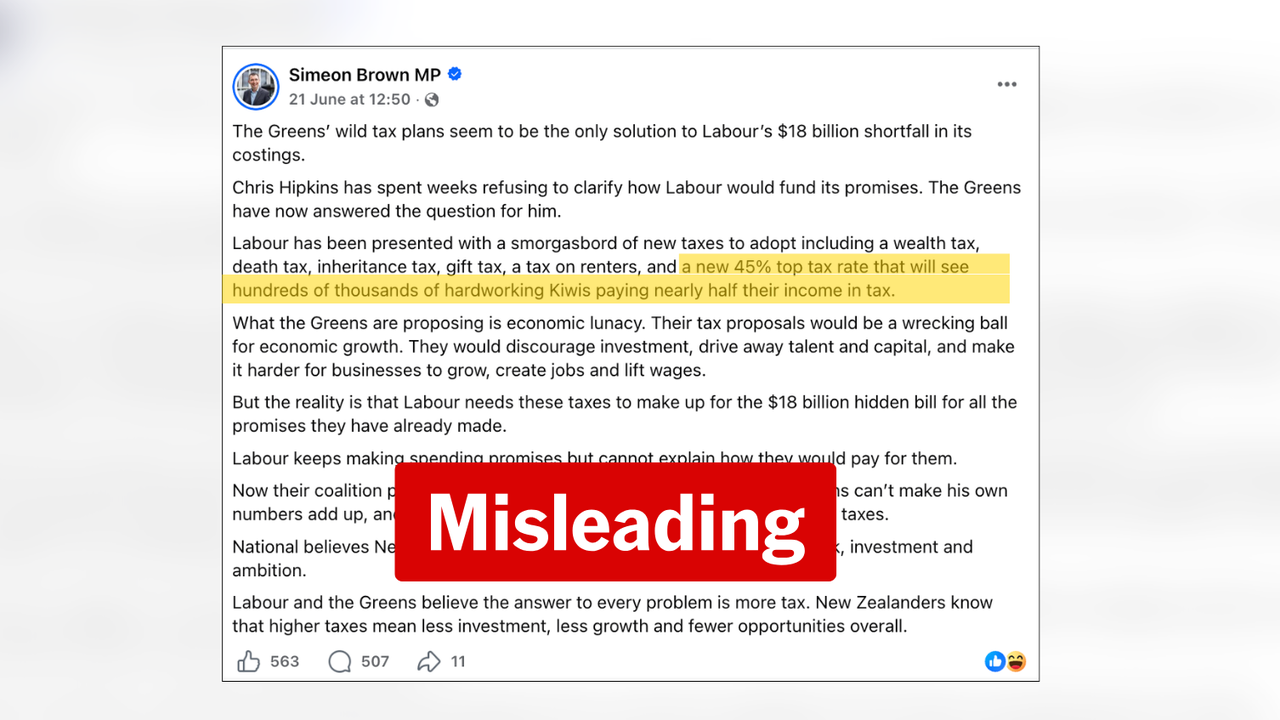
"...Labour has been presented with a smorgasbord of new taxes to adopt including a wealth tax, death tax, inheritance tax, gift tax, a tax on renters, and a new 45% top tax rate that will see hundreds of thousands of hardworking Kiwis paying nearly half their income in tax."
The National Party made a similar claim in a Facebook video.
"If you ever want to earn $160,000, you'd need to pay 45 per cent of it to the Greens and Labour," a man in the video says.
"It's right there in their document."
AAP FactCheck contacted Mr Brown for evidence for his claim, but received no response.

The Green Party's tax policy, released on June 21, proposed a range of income tax changes for individuals, including zero tax on income up to $10,000 and a marginal top rate of 45 per cent for earnings above $160,000 (page 8).
Under the current system, workers pay 10.5 per cent tax on the first $15,600 of income and a top rate of 39 per cent on any income above $180,000.
Like the current system, the Green Party's policy includes progressive tax bands, meaning the more a person earns, the higher their overall income tax rate.
The Green Party's tax policy document claims workers earning $150,000 or less would pay less tax under their plan, and those earning more than $170,000 would pay more (page 8).
While some higher-income earners would pay more under the Green Party's policy, it would not result in hundreds of thousands of people paying nearly half their income in tax, as the National Party has claimed.
Inland Revenue figures show 227,520 people earned more than $160,000 in 2024, the most recent year for which data is available.
Under the Green Party's proposal, only the portion of income above that figure would be taxed at a 45 per cent rate, not a person's entire earnings.
For example, if someone earned $165,000, only $5000 would be taxed at 45 per cent.
This person's total income tax bill would be $44,748.83, or 27.1 per cent of their total earnings, according to AAP FactCheck calculations using the Green Party's proposed tax bands.

Under current tax rates, the same person would have a total bill of $44,326.83, or 26.9 per cent of their earnings, according to AAP FactCheck calculations.
A person earning $165,000 would therefore pay $422 more under the Green Party's proposal.
The nation's highest earners would see a larger proportion of their income taxed under the proposal.
For example, a person earning $1 million a year would have an effective tax rate of 42 per cent, compared with 36.9 per cent currently.
Inland Revenue figures show 2690 people earned more than a million dollars in 2024.
Lisa Marriott, a tax policy expert at Te Herenga Waka-Victoria University of Wellington, said Mr Brown's claim was incorrect.
She referred to a May 2026 article in The Conversation which debunked a similar claim by NSW Premier Chris Minns.
"Even though the context is different, the principles still apply," Professor Marriott told AAP FactCheck.
AAP FactCheck is an accredited member of the International Fact-Checking Network. To keep up with our latest fact checks, follow us on Facebook, Instagram, Threads, X, BlueSky, TikTok and YouTube.