WHAT WAS CLAIMED
The World Bank classifies Australia as a third-world country.
OUR VERDICT
False. The World Bank classifies Australia as a high-income country.
AAP FACTCHECK - A global development organisation has not declared Australia is a third-world country, despite claims online.
The outdated term is not used by the World Bank, which classifies Australia as a "high-income" country.
"Australia is now officially classified as a third-world country by the World Bank!" a June 9 Facebook post reads.
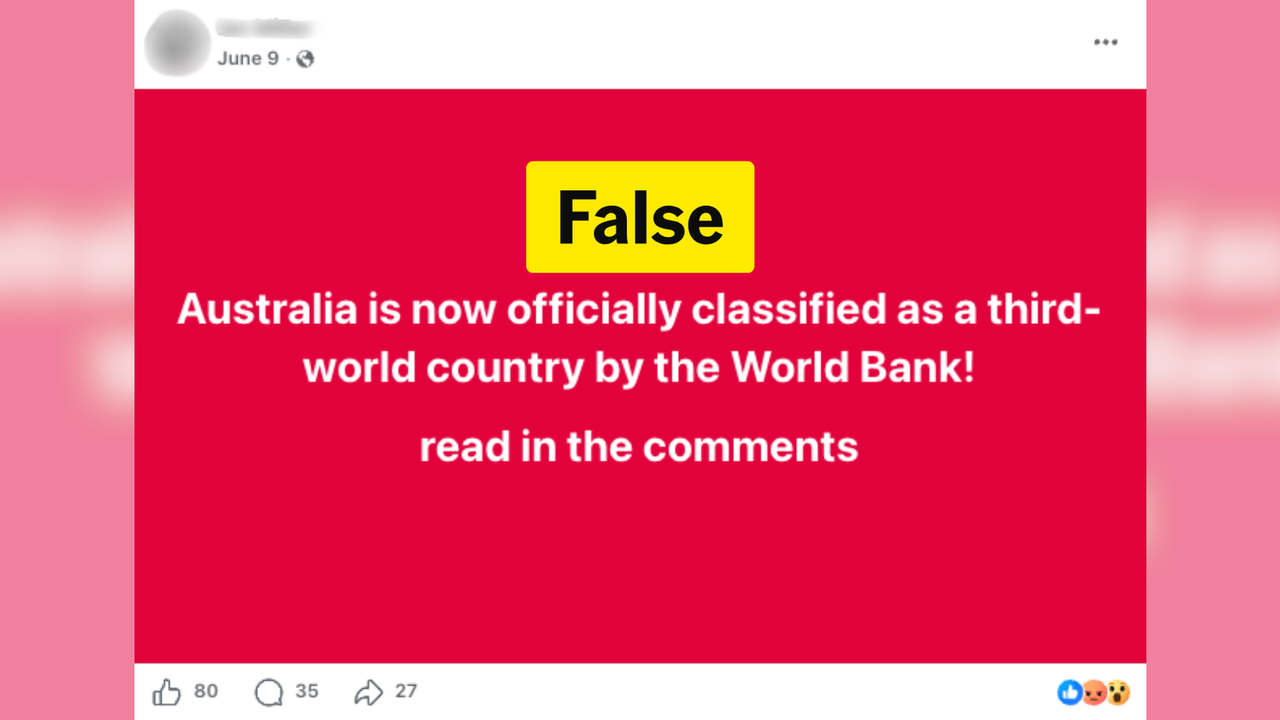
The claim first appeared in an Instagram video clip taken from an Australian property development podcast and was re-shared widely on social media.
"Australia is officially now classified by the World Bank as a third-world country because when your growth management strategy goes past 2.5 per cent, you are then considered a third-world country, which means your infrastructure can no longer keep up with your growth," a real estate developer podcast guest says.
The World Bank consists of two institutions that provide financing, policy advice and technical assistance to the governments of developing nations to support economic development and reduce poverty.
It's part of the wider World Bank Group, which includes an additional three institutions focused primarily on the private sector.

The World Bank Group's 2026-2027 Country Income Classification, which is based on estimates of gross national income per capita, designates Australia as a "high-income" country.
A World Bank spokesperson confirmed this classification remains unchanged.
"The World Bank has not classified Australia as a 'third world country', and no such classification exists within the World Bank's analytical framework," the spokesperson told AAP FactCheck.
Other country classifications include "upper-middle income", "lower-middle income" and "low income" economies.
The phrase "third world" was first coined in 1952 by French demographer Alfred Sauvy, but is no longer widely used by international institutions.
AAP FactCheck is an accredited member of the International Fact-Checking Network. To keep up with our latest fact checks, follow us on Facebook, Instagram, Threads, X, BlueSky, TikTok and YouTube.